

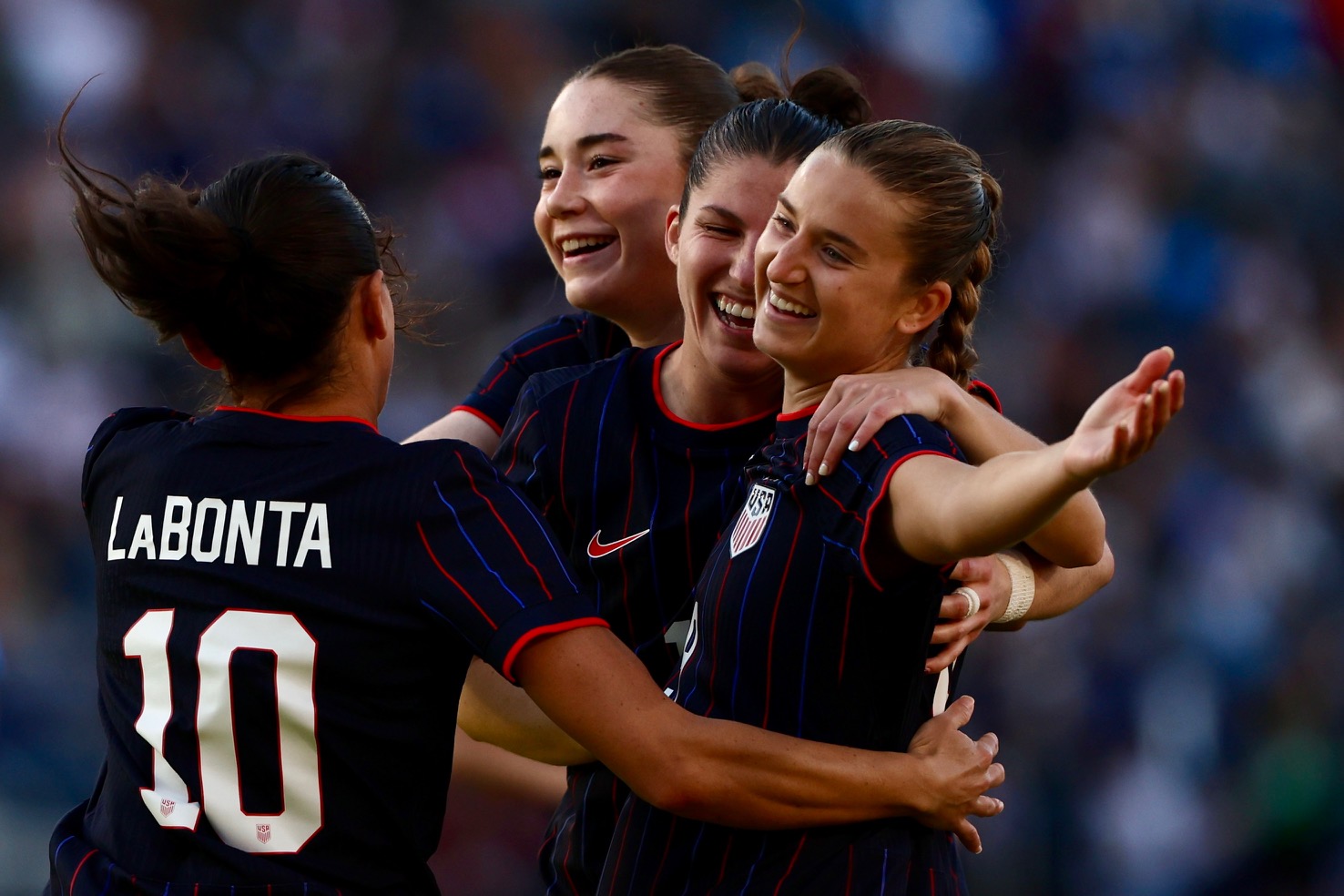
USWNT Roars in California with Statement Wins vs. Paraguay and Chile
The U.S. Women’s National Team (USWNT) opened 2026 in emphatic fashion, showcasing both depth and excitement as they kicked off their year with commanding wins against Paraguay (6–0) at Dignity Health Sports Park in Carson, California, followed by a 5–0 victory over Chile at Harder Stadium on the University of California campus in Santa Barbara. These performances reflect a team in transition that is loaded with youthful ambition, new contributors finding their footing, and a clear direction under newly appointed head coach Emma Hayes.
This January camp marked Emma Hayes’ first steps into her role leading the USWNT in competitive matches. Known for her success with club sides, most notably at Chelsea in the Women’s Super League, Hayes has brought a tactical emphasis on possession, attacking fluidity, and opportunities for emerging players. Her willingness to rotate lineups across these friendlies against Paraguay and Chile demonstrated a commitment to evaluating talent across the roster, not just relying on established stars.
Hayes’ approach has emphasized adaptability and confidence, empowering players with limited international experience to make meaningful contributions. By shifting personnel between matches while maintaining strong results and clean sheets, Hayes has signaled a competitive environment that rewards performance, versatility, and courage.
Playing under sunny Southern California skies, the USWNT opened their 2026 season with a 6–0 rout of Paraguay at Dignity Health Sports Park in Carson. While the U.S. controlled possession and chances throughout, the breakthrough came late in the first half when Reilyn Turner scored her first international goal — fittingly in her first appearance for the national team.
Once halftime arrived, the goals flowed in quick succession. Ally Sentnor logged a brace by scoring twice, including an early second-half strike that set the tone before an own goal from Paraguay’s defense further tilted the scoreline. Trinity Rodman, wearing the captain’s armband, netted her own strike on the night, along with a dazzling signature celebration, followed by Emma Sears adding another to complete the dominant display.
This 6–0 win didn’t just reflect individual moments; it underlined new contributors stepping up, blending experience with fresh energy. It also signaled the new character of the USWNT under Hayes.
Just days later at Harder Stadium, the USWNT returned with a less experienced starting XI, perhaps one of the least capped lineups in decades, yet continued their momentum with a 5–0 win over Chile.
In a night adorned by first-time goal scorers, Croix Bethune, Jameese Joseph, and Emily Sams all found the back of the net for their first international goals. Their decisive strikes, particularly Bethune’s early opener and Sams’ leadership as captain, highlighted the depth emerging within this roster.
Following those debut goals, Emma Sears added another early in the second half before Trinity Rodman capped the scoring and danced again, energizing the home crowd with her trademark flair shortly after entering the match.
This result wasn’t just about winning; it was affirmation that confidence, creativity, and adaptability are spreading throughout the squad. Moreover, it served to validate the distinct transformation and character ushered in by Emma Hayes.
One of the most compelling storylines across both matches was the resurgence and impact of Trinity Rodman. After missing much of 2025 due to injuries, Rodman returned to the USWNT fold and immediately made her presence felt. Her goal against Paraguay marked her first with the national team in nine months, and her performance underscored a renewed confidence that was at least in part enhanced by a historic new professional contract with the NWSL’s Washington Spirit that makes her one of the highest-paid women’s soccer players in the world.
Rodman’s energy on and off the ball has been palpable. Strikingly, both matches saw her celebrate with joy and connection to her teammates and coaching staff alike, symbolizing her excitement to be back in full stride.
Hayes’ comments and Rodman’s demeanor suggest a symbiotic relationship: the coach trusts her star winger to lead by example, and Rodman has responded with confident, decisive play.
With January camp now complete, the USWNT’s attention turns toward the SheBelieves Cup in March and later World Cup qualifying matches. Hayes has clearly used these California friendlies as a testing ground where she focused on assessing tactical patterns, player combinations, and mental resilience.
The confidence built from 11 goals scored and zero conceded across two matches sets a strong foundation for what lies ahead. New goal scorers have emerged, established talents like Rodman are reasserting their influence, and Hayes’ evolving style offers a compelling blend of tactical acuity and opportunity.
If this early season is any indication, the USWNT may be entering one of its most intriguing and dynamic periods in recent memory. The USWNT is blending youth and experience, innovation and tradition, with the clear goal of reasserting global dominance.
Ahsan Awan has been covering sports for over two decades and has been covering US Soccer and the US national team squads since 2014. Images taken by Ahsan Awan for American Presswire and ©2026 American Presswire. Editorial use by American Presswire is unrestricted. Ahsan Awan can be found on X as @quackarazzi and on Instagram as @quackarazzi. American Presswire can be found on X as @ampresswire and on Instagram as @ampresswire.


Becoming Bay: Identity and Evolution in the NWSL
As 2026 begins, Bay FC enters the next phase carrying both the promise of its launch and the reality of what sustained success in the National Women’s Soccer League demands. As one of the league’s newest clubs, Bay FC was never going to be defined by instant dominance. Instead, its early seasons have been about foundation, and that requires establishing culture, building infrastructure, and learning, sometimes painfully, what it takes to compete week after week in the most demanding women’s league in the world.
As the club looks ahead, the question is no longer whether Bay FC belongs in the NWSL. Instead, it has become how quickly the club can transition from a compelling new presence into a consistent playoff contender.
Expansion teams often arrive carrying outsized expectations, particularly in markets with deep soccer roots and high-profile investors. Bay FC was no exception. From its inception, the club positioned itself as a long-term project rather than a short-term gamble, emphasizing sustainability, player support, and community engagement alongside on-field performance.
That approach was evident in Bay FC’s early roster construction. Rather than chasing marquee names for immediate attention, the club focused on assembling a balanced squad that mixed experienced NWSL players with younger talent capable of growing into larger roles. The result was a team that competed with intensity and discipline, even as inconsistency and learning curves inevitably surfaced.
Those early seasons revealed both strengths and shortcomings. Defensively, Bay FC often showed organization and commitment, making matches competitive even against established powers. Offensively, however, chance creation and finishing were areas that required further development. Like many first-year and second-year teams, Bay FC learned that structure alone is rarely enough in a league defined by fine margins.
As Bay FC continues to mature, roster evolution has become central to its next step forward. The transition from simply being competitive to actively chasing playoff spots requires targeted upgrades, not wholesale change. That philosophy has guided the club’s approach to player movement, emphasizing continuity while addressing specific needs.
Additions to the squad have focused on increasing attacking versatility and midfield control. Bay FC has sought players who can break lines, create off the dribble, and relieve pressure in tight spaces. The club has focused on loading up on talent that has the skills that are essential in the NWSL’s increasingly tactical environment. At the same time, the club has been careful to retain core contributors who understand the team’s principles and expectations.
Equally important has been the club’s commitment to player development. Younger players have been given meaningful minutes rather than sheltered roles, reflecting confidence in the long-term payoff of experience gained through adversity. In a league where parity is relentless and roster depth is constantly tested, that developmental emphasis could prove decisive over time.
One of Bay FC’s most significant advantages lies in its organizational clarity. From ownership through technical staff, the club has articulated a consistent vision centered on professionalism, accountability, and growth. That clarity has helped stabilize expectations and allowed players to focus on performance rather than uncertainty.
Coaching continuity has played a critical role in this process. While tactical adjustments have been made in response to league opponents, the broader identity, one built on disciplined defending, structured buildup, and collective effort, has remained intact. For a young club, that consistency is invaluable. It fosters trust, accelerates learning, and reduces the volatility that often undermines expansion teams.
That said, continuity does not imply stagnation. Bay FC’s coaching staff has shown a willingness to adapt, experimenting with formations and personnel to better suit the evolving roster. The challenge moving forward will be maintaining that balance between stability and innovation as expectations rise.
The NWSL is deeper than it has ever been, with established contenders, ambitious mid-table teams, and new entrants all pushing standards higher. For Bay FC, this environment presents both obstacles and opportunity. There are no easy matches, but there are also no insurmountable gaps.
Bay FC’s task is to turn narrow losses and hard-fought draws into points. That shift often comes not from dramatic change, but from refinement. That means improved decision-making in the final third, better game management late in matches, and increased confidence under pressure. These are the details that separate playoff teams from those just outside the line.
The club’s home atmosphere and community connection may also become competitive advantages. Playing in front of a growing, engaged fan base provides energy and identity, reinforcing the sense that Bay FC is building something durable rather than transient.
While playoff qualification is a natural benchmark, Bay FC’s leadership has consistently framed success in broader terms. Player health, professional standards, and long-term competitiveness remain central metrics alongside wins and losses. This perspective reflects an understanding that sustainable success in the NWSL requires patience as well as ambition.
That does not mean expectations are low. On the contrary, the club’s internal standards suggest an organization preparing to raise its ceiling. The groundwork laid in the early years through roster planning, cultural investment, and strategic restraint, has positioned Bay FC to accelerate rather than plateau.
Bay FC’s story is still being written. As the club moves from its formative seasons into a more established phase, the focus will sharpen. Growth will be measured not just in progress, but in outcomes. The leap from promising newcomer to playoff contender is one of the hardest in professional sports, particularly in a league as unforgiving as the NWSL.
Yet Bay FC appears equipped for that challenge. With a clear identity, a thoughtful approach to roster building, and a commitment to long-term vision over short-term noise, the club has positioned itself to become a fixture rather than a novelty.
In a league defined by evolution and competition, Bay FC is doing the work of becoming. The next chapters will determine how quickly that work translates into sustained success, but the foundation suggests a future built not on haste, but on intention.
Ahsan Awan has been covering sports for over two decades and has been covering professional soccer since 2014. All images taken by Ahsan Awan for American Presswire and ©2025 Ahsan Awan for American Presswire, subject to unlimited use under license unless otherwise noted. Ahsan Awan can be found on X as @quackarazzi, on Instagram as @quackarazzi, and on Bluesky as @quackarazzi.bsky.social. American Presswire can be found on X as @ampresswire, on Instagram as @ampresswire, and on Bluesky as @apw.bsky.social.
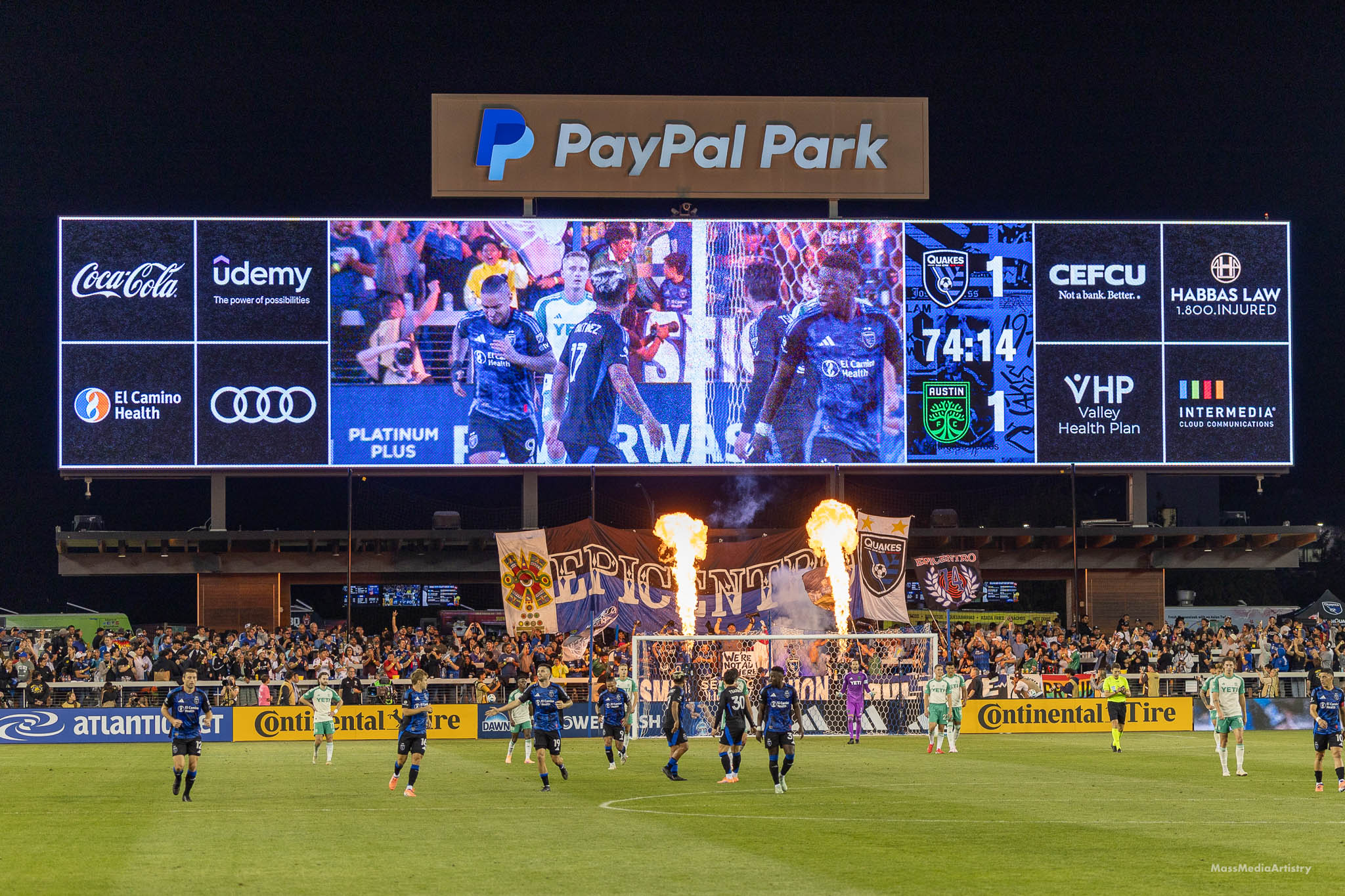
Winds of Change: Roster, Relevance, Owner Flux Challenges Quakes in 2026
The San Jose Earthquakes enter the 2026 Major League Soccer season facing a familiar but increasingly urgent challenge: how to translate history, market potential, and incremental progress into sustained competitiveness. One of MLS’s original clubs, the Earthquakes carry both the weight of legacy and the frustration of recent seasons spent on the margins of the playoff race. As the calendar turns from 2025 to 2026, the organization finds itself in a period of transition defined by roster turnover, uncertainty at the ownership level, and cautious optimism that the pieces may finally be aligning for a return to postseason relevance.
While the Earthquakes have not lacked ambition, the gap between intent and results has been persistent. The 2026 season is shaping up as a proving ground not only for the players and coaching staff, but for the broader direction of the club itself.
The most visible sign of change heading into 2026 is the reshaped roster. San Jose’s 2025 campaign was marked by inconsistency, particularly in defensive organization and chance creation. While there were flashes of attacking promise, the inability to control matches for extended periods ultimately undermined playoff aspirations.
In response, the front office approached the offseason with a clear mandate: re-balance the squad. That effort has meant difficult decisions, including the departure of several veteran contributors whose contracts expired or were moved to create cap flexibility. While those players provided leadership and continuity, the club recognized that incremental tweaks would not be enough to alter its trajectory.
Incoming additions for 2026 reflect a shift in profile and philosophy. San Jose has prioritized younger, more mobile players capable of executing a higher-tempo style while also seeking targeted experience in key positions, particularly central defense and central midfield. The goal is not simply to refresh the roster, but to modernize it in a league that increasingly rewards athleticism, tactical flexibility, and depth.
The Earthquakes have also doubled down on internal development. Homegrown players and recent draft picks are expected to feature more prominently, signaling renewed confidence in the club’s developmental pipeline. For a team operating in one of the most competitive and expensive markets in the league, maximizing academy and domestic talent is not just strategic, it is essential.
However, roster changes alone do not define a team’s evolution. The Earthquakes’ progress toward playoff contention will depend heavily on how effectively those pieces are integrated on the field. Over recent seasons, San Jose has oscillated between styles, at times pressing aggressively and at others retreating into a more conservative shape. The lack of a consistent identity has often left the team vulnerable, particularly against disciplined opponents.
Heading into 2026, there is a renewed emphasis on clarity. The coaching staff has signaled a commitment to a system that balances controlled possession with quick vertical transitions. The aim is to reduce defensive exposure while allowing attacking players the freedom to exploit space rather than forcing low-percentage chances.
Continuity on the sidelines offers a chance for that vision to take hold. MLS history is filled with examples of teams that stagnated under constant turnover, and San Jose appears intent on avoiding that trap. With a clearer tactical framework and a roster better suited to execute it, the Earthquakes hope to close the gap between competitive performances and tangible results.
Perhaps the most consequential question surrounding the Earthquakes has nothing to do with tactics or personnel. The ongoing search for a new team owner looms large over the club’s future, shaping both perception and practical reality.
Ownership uncertainty has long been a complicating factor in San Jose’s ability to compete consistently within MLS. While the club has maintained operational stability, limitations in investment have often placed it at a disadvantage relative to more aggressively funded rivals. In a league where spending on designated players, infrastructure, and analytics increasingly separates contenders from also-rans, that gap has been difficult to ignore.
The hope among supporters and league observers is that new ownership could bring not only financial resources but also a renewed sense of ambition. San Jose remains an underleveraged market, situated in the heart of Northern California with access to a diverse fan base and corporate ecosystem. A committed ownership group could transform the Earthquakes’ ceiling, enabling investment in roster depth, training facilities, and long-term strategic planning.
At the same time, the transition carries risk. Ownership changes can disrupt continuity, alter priorities, and introduce uncertainty for players and staff. The challenge for the club in 2026 will be maintaining focus on the field while navigating developments off it. The complexity is not to be taken lightly. This is a balancing act that will test leadership at every level of the organization.
For the Earthquakes, the bar in 2026 is not abstract ambition but concrete improvement: becoming playoff eligible. In MLS, parity is both a blessing and a challenge. Small gains can yield significant jumps in the standings, but sustained mediocrity can just as easily keep a team trapped in the middle or bottom of the table.
San Jose’s path to the postseason depends on a handful of critical factors. Defensive consistency must improve, particularly in road matches where points have been historically hard to come by. The midfield must provide both stability and creativity, allowing the team to dictate games rather than react to them. On the attack, efficiency will be paramount. Promising buildup must turn into goals rather than squandered opportunities.
Equally important is mentality. Playoff teams are often distinguished not by overwhelming talent, but by resilience and belief. Late goals conceded, dropped points from winning positions, and extended winless runs have plagued San Jose in recent seasons. Addressing those patterns requires more than tactical tweaks, it demands a cultural shift toward expectation rather than hope.
As the 2026 season approaches, the San Jose Earthquakes stand at a defining moment. The roster changes from 2025 signal a willingness to confront hard truths. The ongoing search for new ownership underscores the need for structural evolution. And the stated goal of playoff eligibility provides a clear benchmark by which progress will be measured.
For supporters, the coming year offers cautious optimism tempered by realism. The Earthquakes are not promising instant transformation, but they are laying groundwork on and off the field in pursuit of a more competitive future. Whether that foundation is strong enough to carry the club back into the postseason in 2026 remains to be seen.
What is certain is that this coming season will matter a lot. In a league that rewards momentum and punishes stagnation, the Earthquakes have an opportunity to redefine their narrative. If roster evolution, tactical clarity, and organizational direction align, San Jose could finally begin the long climb from perennial outsider to playoff participant, or perhaps something more.
Ahsan Awan has been covering sports for over two decades, and has been covering professional soccer, including MLS and the San Jose Earthquakes, since 2014. All images taken by Ahsan Awan and Rouse for American Presswire and ©2025 Ahsan Awan and John Rouse, separately, for their respective contributions, to and for American Presswire, subject to unlimited use under license unless otherwise noted. Ahsan Awan can be found on X as @quackarazzi and on Instagram as @quackarazzi. American Presswire can be found on X as @ampresswire, on Instagram as @ampresswire, and on Bluesky as @apw.bsky.social.

Pitch and Pivot: USWNT at the crossroads
The United States Women’s National Team enters 2026 standing at a familiar yet challenging crossroads. Long regarded as the gold standard of women’s international soccer, the USWNT is simultaneously defending its legacy and redefining itself in a global game that has never been deeper, faster, or more tactically complex. The past year has been one of transition, evaluation, and recalibration, and the opening months of 2026, beginning with matches in Los Angeles and Santa Barbara, will provide early clues as to how successfully the team is shaping its next era.
Under Head Coach Emma Hayes, the program continues to move deliberately away from reliance on historic dominance and toward a more adaptable, modern identity. That evolution has been visible in the team’s most recent matches played on U.S. soil, where promising performances have been paired with moments that underscore how narrow the margin for error has become at the international level.
The USWNT closed its most recent domestic run with a pair of international friendlies against Italy, a European side opponent that exemplifies the growing tactical sophistication across the women’s game. These matches, played in Florida, served both as competitive tests and as laboratories for Hayes to assess player combinations and strategic balance.
In the first match, held in Orlando, the United States delivered one of its most complete performances of 2025, earning a 3-0 victory. The USA controlled possession, dictated tempo, and converted chances with confidence. Catarina Macario led the way with two goals, showcasing her clinical finishing and playmaking ability, while Olivia Moultrie’s early strike set the tone. Beyond the score line, the match demonstrated the USWNT’s ability to break down a disciplined European defense through patience rather than sheer physicality.
The second match of the series, played in Fort Lauderdale, ended in a 2-0 win and reinforced the sense of progress. While less explosive, the performance highlighted improved defensive organization and composure in midfield. The team’s ability to manage the game, rather than chase it, reflected a growing maturity that Hayes has emphasized since taking the helm.
Those wins followed a more mixed October window, during which the USWNT experienced both frustration and resurgence. A 2-1 loss to Portugal served as a reminder that even historically dominant programs can be punished for lapses in concentration. The USA responded emphatically in subsequent matches, including a commanding win over New Zealand, reasserting their attacking potential and depth.
Taken together, the recent home matches painted a clear picture: the USWNT remains a formidable force, but one that is learning to win in new ways. The days of overwhelming opponents through athletic superiority alone are fading, replaced by an emphasis on tactical flexibility, technical precision, and collective intelligence.
As 2026 begins, the state of the USWNT can best be described as transitional rather than rebuilding. Unlike past cycles that required wholesale changes following retirements, this phase has focused on integrating new contributors alongside established leaders.
Veteran players such as Rose Lavelle and Catarina Macario continue to anchor the squad, providing creativity, composure, and experience. At the same time, younger players have been entrusted with meaningful roles, signaling confidence in the next generation. Hayes has been unapologetic about experimentation, rotating lineups and formations even in high-profile matches, with the long-term goal of building a roster capable of adapting to varied opponents and tournament conditions.
Tactically, the team has moved toward a more possession-oriented approach while retaining its trademark intensity in pressing and transition moments. The emphasis is on balance, knowing when to dominate the ball, and knowing when to exploit space quickly. Defensively, there has been a renewed focus on structure and discipline, particularly against opponents who thrive on quick counters and technical buildup.
Perhaps most importantly, the program has embraced a cultural shift. Leadership is no longer concentrated in a handful of iconic figures; instead, responsibility is being shared across the roster. This evolution reflects both necessity and opportunity as the team prepares for the next major cycle of international competitions.
The USWNT’s first matches of 2026 will take place in Southern California. These games are more than preseason warm-ups; they represent the opening chapter of a year that will shape the program’s immediate future.
On January 24, the USWNT will face Paraguay at Dignity Health Sports Park in Carson. The venue is synonymous with the USWNT, having hosted more matches than any other stadium in the world. Paraguay offers a contrasting style rooted in South American technical play and defensive compactness, providing an early test of the USA’s ability to unlock organized opponents.
The match will also carry emotional significance, as it includes a celebration honoring Christen Press, a Los Angeles native and longtime USWNT standout. Her recognition serves as a bridge between eras, acknowledging the legacy that built the program while underscoring its continued evolution.
Three days later, on January 27, the USWNT travels north to Harder Stadium in Santa Barbara to face Chile. This match marks the first time the women’s national team will play an international fixture on California’s Central Coast, expanding the team’s geographic footprint and bringing elite women’s soccer to a new community. Chile presents another competitive challenge, one that will likely demand patience and tactical discipline from the Americans as they seek to build on lessons learned earlier in the camp.
The significance of these January matches extends beyond their immediate results. They provide critical opportunities for players to establish roles, for coaching staff to refine strategies, and for the team as a whole to build cohesion ahead of more consequential competitions later in the year, including regional championships and qualification campaigns.
In a global environment where parity continues to increase, every international window matters. Friendlies are no longer mere exhibitions; they are essential steps in preparation and identity formation. For the USWNT, the challenge in 2026 is not simply to win, but to demonstrate that the program’s evolution is producing a team capable of thriving against the best in the world.
As the USA takes the field in Los Angeles and Santa Barbara, the message is clear: the next chapter of the USWNT is underway. Rooted in a storied past but focused firmly on the future, the team enters 2026 determined to prove that adaptation, not nostalgia, will define its continued success.
Ahsan Awan has been covering sports for over two decades and has been covering US Soccer and the US national team squads since 2014. Images taken by Juan Carlos Ruiz for American Presswire and ©2025 American Presswire. Editorial use by American Presswire is unrestricted. Ahsan Awan can be found on X as @quackarazzi and on Instagram as @quackarazzi. American Presswire can be found on X as @ampresswire and on Instagram as @ampresswire.

Bouda Shines Bright as Quakes Claim First Leg of Clasico
The California Clasico—one of Major League Soccer’s fiercest rivalries—delivered another chapter of drama, passion, and regional pride on Wednesday, May 28, 2025. In front of a formidable crowd at Dignity Health Sports Park in Carson, California, the San Jose Earthquakes edged out the LA Galaxy with a narrow but decisive 1-0 win in the first leg of the 2025 edition of the Clasico. The difference-maker? A sensational 74th-minute strike from none other than San Jose’s rising star, forward Ousseni Bouda.
At 25 years old, Bouda is rapidly establishing himself as one of the league’s most electrifying talents. The Burkina Faso international’s pace, agility, and attacking instincts have earned him accolades across MLS, and his latest performance further solidified his growing legend. With this victory, the Earthquakes not only claimed bragging rights over their Southern California rivals but also climbed into playoff position, sitting 7th on the Western Conference table with 22 points, just one behind rival LAFC, and ten shy of the current division leader, the Vancouver Whitecaps.
The California Clasico is far more than just another MLS fixture. With roots going back to the league’s inception, the rivalry between the LA Galaxy and the San Jose Earthquakes reflects a broader cultural and sporting competition between Northern and Southern California. Fueled by years of dramatic finishes, playoff encounters, and unforgettable moments, this rivalry has often served as a measuring stick for both clubs.
Heading into this match, the stakes were higher than usual. The Earthquakes were hovering just outside playoff contention, while the Galaxy were seeking to get off the bottom of the table. Both teams have shown flashes of brilliance this season, but both have also struggled with consistency. The match in Carson was a pivotal opportunity for each to stake a claim of state and regional supremacy.
From the opening whistle, the tension was palpable. The Galaxy, buoyed by a home crowd clad in blue and gold, sought to dictate the tempo early on. The Galaxy controlled possession in the opening stages, probing San Jose’s defensive lines. The return of Earthquakes star defender Rodrigues all but ensured the backline would not break. Earthquakes manager Brice Arena, no stranger to LA or to the Galaxy, clearly drilled his side to absorb pressure and counterattack with intent.
San Jose’s defensive line stood tall under waves of Galaxy pressure, aided by a standout performance from goalkeeper Earl Edwards, who continues to protect the net while Daniel is out. Edwards made key saves to keep the match scoreless. The Quakes’ counterattacks, meanwhile, relied heavily on the speed and creativity of Cristian Espinoza, until the 87th minute, and eventually Ousseni Bouda, who entered the math in the 66th minute, continually tested the Galaxy backline.
As the second half wore on, the game became increasingly stretched. The Galaxy pushed numbers forward in search of a breakthrough, leaving themselves exposed to the counter—exactly what the Earthquakes had been waiting for.
In the 74th minute, that moment arrived. A quick transition saw Espinoza collect the ball deep in midfield before threading a perfectly weighted pass into space behind the Galaxy defense. Bouda, who had been lurking on the shoulder of the last defender, timed his run to perfection. Bursting forward with trademark acceleration, he glided past center back Maya Yoshida and coolly slotted the ball past Galaxy keeper Novak Micovic with his left foot.
The San Jose bench erupted, and the traveling Earthquakes supporters made their voices heard. It was Bouda’s third goal of the season, but arguably his most important, coming in the club’s marquee rivalry match and at a moment when points were badly needed.
Born in Ouagadougou, Burkina Faso, Bouda’s journey to MLS stardom has been marked by perseverance and brilliance. A standout at Stanford University, he was drafted by the Earthquakes in 2022 and has steadily grown into a key figure for the club. Now in his fourth professional season, Bouda is enjoying a breakout year.
His recent nomination for the 2025 MLS All-Star Game is no surprise to those who have followed his progression. With his electric footwork, explosive speed, and unrelenting work rate, Bouda brings an X-factor that can turn games on their head. Wednesday night’s goal was a perfect encapsulation of his style—swift, instinctive, and clinical.
The victory over LA Galaxy gave San Jose three critical points, propelling them from 9th to 7th place in the Western Conference standings. They now sit in the final playoff spot, just one point behind their other LA rival, LAFC. The Vancouver Whitecaps, enjoying a dominant season, remain ten points clear at the top.
More importantly, the win reignited belief among Earthquakes fans that this team, often seen as a rebuilding project in recent years, could make a genuine push toward postseason contention. With momentum on their side and Bouda in top form, San Jose will be a team to watch in the coming weeks.
The second leg of the California Clasico, scheduled to take place later this summer at Stanford Stadium, now carries even more significance. Not only will it offer the Galaxy a chance at redemption, but it may also have playoff implications for the Earthquakes, depending on how the team performs in the interim. The next three matches, all on the road, are a significant test. At St. Louis, at Portland, and at Dallas; the Earthquakes will be in great shape if they can simply avoid a loss, let alone earning even one win.
Furthermore, for the Earthquakes, the big challenge will be maintaining consistency. While their defense has been improving steadily, their attack has often struggled with finishing. If Bouda continues to lead the line with the confidence and flair he displayed in Carson, San Jose may have found their talisman at just the right time.
The Earthquakes return home to face the LA Galaxy in the second leg of the California Clasico at Stanford Stadium in Palo Altom California on Saturday, June 28, 2025. The match is scheduled to kick off at 7:30 PM Pacific time.
Ahsan Awan has been covering sports for over two decades, and has been covering professional soccer, including MLS and the San Jose Earthquakes, since 2014. All images taken by Trinity Machan for American Presswire and ©2025 Trinity Machan for American Presswire subject to unlimited use under license unless otherwise noted. Ahsan Awan can be found on X as @quackarazzi and on Instagram as @quackarazzi. Trinity Machan can be found on X as @MachanTrinity and on Instagram as @saltlakephotoco. American Presswire can be found on X as @ampresswire, on Instagram as @ampresswire, and on Bluesky as @apw.bsky.social.

Earthquakes Secure 2-1 Victory Over Republic in U.S. Open Cup Round of 32
On May 7, 2025, the San Jose Earthquakes hosted Sacramento Republic FC at PayPal Park in San Jose, California, for a Round of 32 match in the Lamar Hunt U.S. Open Cup. The Earthquakes emerged victorious with a 2-1 win, advancing to the Round of 16.
The Earthquakes began the match aggressively with Amahl Pellegrino finding the back of the net early in the second minute off a double assist by both Preston Judd and Mark-Anthony Kaye. This set the tone for the match as Republic came out with a heavy defensive lineup that was simply unable to answer. The Earthquakes scored again in the 44th minute as Preston Judd found the back of the net, this time off another double assist by both Niko Tsakiris and Nick Lima.
Pellegrino had many opportunities to add to his first goal. He quite possibly could have logged a hat trick, even a double hat trick, on the night. The action was exciting even though he missed. Luckily for the Earthquakes, goalkeeper Earl Edwards did a solid job protecting the net.
The match also featured the long-anticipated return of Hernán López. Returning to action after having shoulder surgery in mid-March, he entered in the 66th minute and played until the final whistle.
Unfortunately, San Jose's Jamar Ricketts earned a red card in the 83d minute. He will therefore be unavailable for the next match.
For their part, Republic would not go down easy. Having defeated the Earthquakes in 2024, the club was confident they could compete. A late goal by Trevor Amann, off an assist by decorated veteran Rodrigo Lopez in the 96th minute, brought the final score to 2-1.
The Earthquakes would end the night advancing to the Round of 16 where they will face a Portland Timbers MLS squad they just beat 4-1 at PayPal Park only days earlier. The match will be played May 20 at PayPal Park.
Ahsan Awan has been covering sports for two decades, and has been covering professional soccer, including MLS, since 2014. All images taken by Ahsan Awan for American Presswire and ©2025 Ahsan Awan for American Presswire subject to unlimited use under license unless otherwise noted. Ahsan Awan can be found on X as @quackarazzi and on Instagram as @quackarazzi.

Whitecaps Dominate Inter Miami in First Leg of CONCACAF Champions Cup Semifinal
In a historic night at BC Place, Major League Soccer’s Vancouver Whitecaps FC delivered a commanding 2-0 victory over fellow league club Inter Miami CF in the first leg of their 2025 CONCACAF Champions League semifinal. The match, played on Thursday, April 24, 2025, before a record crowd of 53,837 fans, showcased the Whitecaps' tactical discipline, clinical finishing, and unwavering determination.
The atmosphere at BC Place was electric, with a new attendance record for the stadium, the fans, clad in white and blue, created an intimidating environment for the visiting Inter Miami squad, amplifying the significance of the occasion.
Under the guidance of head coach Jesper Sørensen, the Whitecaps executed a well-organized defensive strategy, stifling Inter Miami's attacking threats. The midfield trio of Andrés Cubas, Damir Kreilach, and Sebastian Berhalter controlled the tempo, disrupting Miami's rhythm and initiating counterattacks.
The Whitecaps' offensive prowess was evident as they capitalized on their opportunities. Brian White opened the scoring in the 24th minute, converting a precise cross into the box. Later, in the 85th minute, Sebastian Berhalter sealed the victory with a composed finish following a swift counterattack orchestrated by Jayden Nelson.
Inter Miami, featuring global stars like Lionel Messi and Luis Suárez, struggled to break down Vancouver's defense. Messi's influence was limited, and Suárez's ongoing goal drought continued, raising concerns about the team's offensive cohesion. The disunity was perhaps somewhat expected, and surely ironic, given the same day news of the trade of forward Robert Taylor to Austin FC. Any time a significant presence departs, there is a change in chemistry. On this night, that change would not be good for Miami.
With a two-goal advantage heading into the second leg on April 30 at Chase Stadium in Fort Lauderdale, Florida, the Whitecaps are poised to make history. A solid defensive performance and disciplined approach will be crucial as they aim to secure their place in the final and continue their remarkable run in the tournament.
Ahsan Awan has been covering sports for two decades, and has been covering professional soccer, including MLS, since 2014. All images taken by Luanna Andrade for American Presswire and ©2025 Luanna Andrade for American Presswire subject to unlimited use under license unless otherwise noted. Ahsan Awan can be found on X as @quackarazzi and on Instagram as @quackarazzi. Luanna Andrade can be found on X as @luannacta_ and on Instagram as @luannaandradefoto.

NPSL's El Farolito Falls to USL's Sacramento Republic FC in US Open Cup Third Round
On Wednesday, April 16, 2025, at 7:00 PM Pacific Time, San Francisco's beloved amateur soccer team, El Farolito, faced USL Championship side Sacramento Republic FC in the third round of the Lamar Hunt U.S. Open Cup. The match took place at Heart Health Park, located in Sacramento, CA.
Founded in 1985 by Salvador “Don Chava” Lopez, El Farolito began as a small taqueria in San Francisco's Mission District. Over the years, it has grown into a beloved institution, with multiple locations serving some of the city's most iconic burritos. But beyond the culinary delights, El Farolito is also home to a soccer team that has captured the hearts of many people.
The team, often referred to as the "Burrito Boys," has a rich history in the U.S. Open Cup. In 1993, they won the prestigious tournament under the name San Francisco CD Mexico. Their success was not just on the field but also in fostering a sense of community and pride among the Latino population in the Bay Area. The team's ethos revolves around family, culture, and the love of the game.
In 2024, El Farolito added another chapter to their storied legacy by winning the National Premier Soccer League (NPSL) championship, defeating FC Motown 2–1. Their journey in the U.S. Open Cup that year was nothing short of remarkable, with standout performances from players like Dembor Benson, who scored crucial goals in the tournament.
The 2025 season has seen El Farolito continue their impressive run. They secured victories over multiple notable opponents including Real Monarchs and Monterey Bay FC, both USL Championship teams, to reach the third round of the U.S. Open Cup.\
Sacramento Republic FC, established in 2012, has quickly become a powerhouse in the USL Championship. The team has a rich history in the U.S. Open Cup, having participated in every tournament since 2014. Notably, they are the only second-division team to reach the U.S. Open Cup Final since 2008, defeating three MLS side clubs in the 2022 tournament, only to fall in heartbreaking fashion in the cup final versus MLS side Orlando City SC after a string of controversial incidents in the lead up to the match that left many wondering whether fair play was compromised.
For Republic FC, participation in the 2025 U.S. Open Cup follows what has come to be a long tradition. They have been a dominant force in the west. Their entry into the third round of the 2025 Open Cup is a testament to their commitment to success and their desire to challenge themselves against top-tier competition.
The match between El Farolito and Republic FC was more than just a game; it was a celebration of soccer's ability to unite diverse communities. El Farolito, with its deep roots in the Latino community of San Francisco, brings a unique blend of passion, culture, and underdog spirit. Sacramento, with its professional pedigree and history of success, represents the pinnacle of second-division soccer in the United States.
For El Farolito, this match was an opportunity to continue their Cinderella story and prove that heart and determination can overcome the odds. For Sacramento, it was a chance to assert their dominance and remind the soccer world of their pedigree in the lead up to USL’s launch of USL D1 and the promotion-relegation format across divisions.
Unfortunately, for El Farolito, this match would be their last in this year’s Open Cup tournament. The club fell 0-1 to Republic FC. With chilly winds swirling throughout the match, the boys in old glory red found the back of the net in the 29th minute on a brilliant header by Sebastian Herrera that came off an assist by Rodrigo Lopez. Lopez’s current 12 assists in Open Cup play make him the all-time assist leader in tournament history. After that goal, El Farolito began to break down. Their play became frenetic. Communication both on the pitch and from the sideline deteriorated and leadership seemed to diminish. Despite their high energy and aggressive play, El Farolito was simply unable to equalize. Sacramento’s keeper did an excellent job protecting the net and earned a clean sheet.
Sacramento ascended to the Round of 32 where they will face a familiar foe, the MLS side San Jose Earthquakes. That match will be played at PayPal Park in San Jose, CA on May 7.
Ahsan Awan has been covering sports for over two decades, professional soccer since 2014, and USL side Sacramento Republic FC since their inaugural season. All images taken by Ahsan Awan for American Presswire and ©2025 Ahsan Awan for American Presswire subject to unlimited use under license unless otherwise noted. Ahsan Awan can be found on X as @quackarazzi and on Instagram as @quackarazzi.

Bay FC Falls 2-1 to Red Stars at PayPal Park
Bay FC suffered a narrow 2-1 defeat to the Chicago Red Stars on April 13, 2025, at PayPal Park in San Jose, California. The match showcased both teams' resilience and highlighted key moments that ultimately decided the outcome.
The game began with high intensity, and Chicago took an early lead in the 5th minute as the amazing Ludmila da Silva found the back of the net. It would be the first of two goals for the Brazilian forward as she was able to secure the brace by scoring again in the 41st minute. Bay FC simply had no defensive answer for her relentless play up top.
Bay FC took a step forward in the 58th minute by successfully converting a penalty kick taken by Caroline Conti. This brought the score to 2-1, where it remained for the rest of the match. That’s not to say that Bay FC didn’t have chances, but they were unable to get through either the Chicago backline or their goalkeeper, Alyssa Naeher. Coming off a trio of losses, including a devastating 6-0 loss to Orlando just a month earlier, Naeher wasn’t invincible by any stretch. The Bay FC frontline was simply unable to capitalize and was hardly able to penetrate.
Undeterred, Bay FC pushed forward in search of an equalizer. Nobody on the pitch ever gave up. Nobody showed signs of upset or frustration. The team believed it could win until the final whistle in stoppage time. Racheal Kundananji was unable to find success from the left wing where perhaps she seemed out of position given the matchups, but she never quit.
Despite the defeat, Bay FC remains competitive in the league. Currently in the 8th spot on the table behind Portland and Seattle, and just above San Diego, the club is right in the middle. Their ability to create scoring opportunities and their depth in attacking options will be crucial as they continue their 2025 campaign. Head coach Albertin Montoya's strategic adjustments and the players' commitment to the team's objectives will be key factors in their pursuit of success.
As Bay FC reflects on this match, they will aim to build on their strengths and address areas for improvement. The team's focus will be on maintaining their offensive momentum and tightening their defense to secure positive results in upcoming fixtures.
Bay FC's next match is against the North Carolina Courage on April 19th. They have an opportunity to rebound and demonstrate their growth and determination. It won’t be easy. Despite a 0-2-2 record good for 13th place no the table, playing and winning on the road is never a simple task.
Ahsan Awan has been covering sports for two decades and has been covering professional soccer since 2014. All images taken by Ahsan Awan for American Presswire and ©2025 Ahsan Awan for American Presswire subject to unlimited use under license unless otherwise noted. Ahsan Awan can be found on X as @quackarazzi and on Instagram as @quackarazzi.

Whitecaps Triumph Over Pumas UNAM in CONCACAF Champions Cup Quarterfinals
In a historic display of resilience and tactical prowess, MLS side Vancouver Whitecaps FC secured their spot in the semifinals of the 2025 CONCACAF Champions Cup by overcoming Liga MX powerhouse Pumas UNAM. The two-legged quarterfinal series concluded with a 2-2 draw in Mexico City, propelling the Canadian side forward on the away goals rule—a significant milestone in the club's history.
The series began on April 2, 2025, at Vancouver's BC Place Stadium. Both teams entered the match with high expectations, understanding the importance of setting the tone for the aggregate series.
Vancouver started the game with intensity, creating early chances. In the 4th minute, midfielder Caden Clark fired a shot from inside the box that narrowly missed the target. The Whitecaps continued to press, with defender Tristan Blackmon testing Pumas goalkeeper Álex Padilla in the 38th minute with a powerful long-range effort that Padilla managed to deflect wide.
The second half saw Vancouver's Edier Ocampo having a promising opportunity in the 63rd minute, getting behind the Pumas defense but lifting his shot over the bar. Pumas' first real test for Vancouver goalkeeper Yohei Takaoka came in the 65th minute, with defender José Caicedo's long-range effort requiring a diving save.
The match concluded in a 1-1 draw, with both teams sharing the spoils. Vancouver's performance was notable, especially considering they were without five injured players, including captain Ryan Gauld, who was sidelined with a knee injury.
The return leg on April 9, 2025, at Estadio Olímpico Universitario in Mexico City was set to be a true test of Vancouver's character and determination. Facing a formidable Pumas side in their home territory, the Whitecaps knew they had to overcome the odds to advance.
The match began with Pumas applying pressure, aiming to overturn the aggregate score. However, Vancouver's defense remained steadfast, with Takaoka making crucial saves to keep the hosts at bay. The breakthrough came in the 51st minute when Pumas' Luis Quiñones capitalized on a rebound inside the box, giving the Mexican side the lead and leveling the aggregate score at 2-2.
Undeterred, Vancouver continued to press forward. In the 65th minute, a quick counter-attack saw Brian White find space in the box, but his shot was saved by Padilla. The decisive moment arrived in the 85th minute when White's persistence paid off. A well-delivered cross from the right found White, who rose above the defenders to head the ball past Padilla, giving Vancouver a crucial away goal and a 3-2 aggregate lead.
Pumas pushed forward in the final minutes, but Vancouver's defense, led by the experienced Mathías Laborda, remained resolute. The match concluded 2-1 in favor of Pumas, but with the aggregate score tied at 3-3, Vancouver advanced on the away goals rule.
This victory marks a significant achievement for Vancouver Whitecaps FC. Not only did they eliminate a Liga MX team—a feat few MLS teams have accomplished—but they also did so by overcoming a first-leg deficit and withstanding intense pressure in the return leg.
Head coach Jesper Sørensen's tactical acumen was evident throughout the series. His ability to adapt to different game situations, manage player rotations, and maintain composure under pressure were key factors in the team's success. Sørensen's leadership has transformed the Whitecaps into a formidable force in North American soccer, challenging traditional powerhouses and setting new standards for the club.
With the semifinal draw complete, Vancouver Whitecaps FC will face MLS rivals Inter Miami CF. The first leg is scheduled for April 24, 2025, at BC Place in Vancouver, with the return leg on April 30 at Chase Stadium in Miami.
Inter Miami, led by the legendary Lionel Messi, has been in scintillating form, making this matchup one of the most anticipated in recent memory. Vancouver's defense will have the challenging task of containing Messi and his teammates, while the Whitecaps' attacking unit will look to exploit Inter Miami's defensive vulnerabilities.
The Whitecaps' performance against Pumas UNAM in the CONCACAF Champions Cup quarterfinals has solidified their status as a rising force in North American soccer. Their ability to compete with and overcome traditional powerhouses like Pumas showcases the growth and development of the MLS and the increasing competitiveness of its teams on the international stage.
As the Whitecaps prepare for their semifinal clash with Inter Miami CF, fans and pundits alike will be watching closely to see if the club can continue their historic run and potentially lift the CONCACAF Champions Cup, further cementing their legacy in the annals of soccer history.
Ahsan Awan has been covering sports for two decades, and has been covering professional soccer, including MLS, since 2014. All images taken by Luanna Andrade for American Presswire and ©2025 Luanna Andrade for American Presswire subject to unlimited use under license unless otherwise noted. Ahsan Awan can be found on X as @quackarazzi and on Instagram as @quackarazzi. Luanna Andrade can be found on X as @luannacta_ and on Instagram as @luannaandradefoto.